Already running a client in another program? Its account statement is imported: accounts, entries, owners, tenants and incoming payments. Whatever Swiss-Immo can produce itself is deliberately NOT imported — otherwise it would appear twice.
-
1
Create the mandate and enter the master data: properties, units, tenants, rent and service-charge advance.💡 The order matters: from the rents, Swiss-Immo raises the monthly charges itself. That is why the import does not bring them along.
-
2
Under Import, upload the old program's account statement (PDF, CSV or text) and check the detected sections.
-
3
Map the accounts and run the import. At the end you see what went into the ledger and what went into rent collection.💡 The summary also shows a check: the annual rent due from the old program against what Swiss-Immo will raise from your master data, tenant by tenant.
-
4
Check the result in rent collection and in the ledger. If something is off, upload the same file again and choose Roll back and re-import.
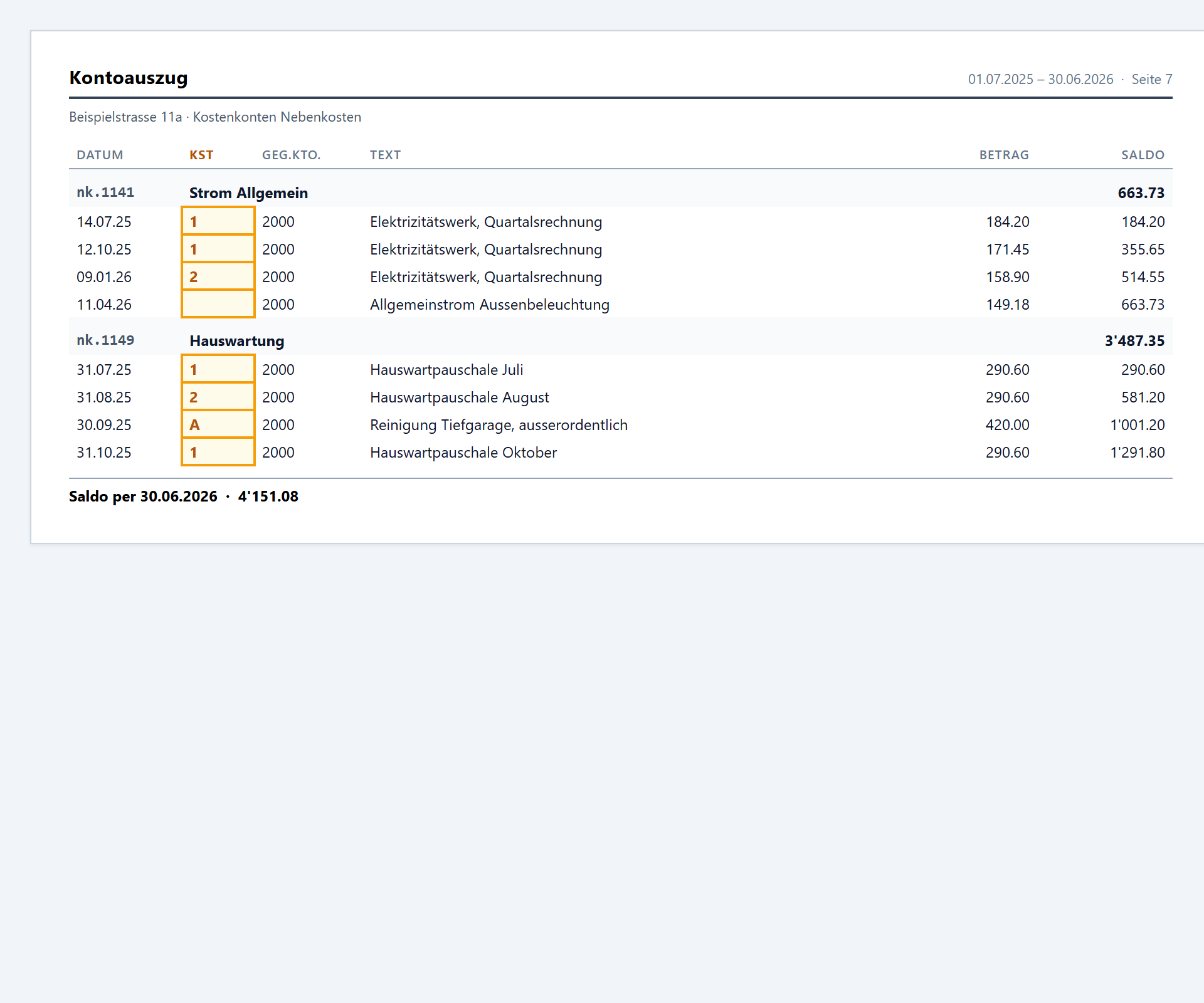
- •Cost centres say who a booking concerns — and that decides who pays it. If your statement has a „KST“ column (cost centre), the import asks for each one: do these costs belong to all of the client’s properties, to one specific property — or to one specific owner? The third case exists because a building can belong to several owners, and some costs concern only one owner’s flats. Older programs often create a second property and append the owner’s name: it looks like two buildings but is one. Here it stays ONE property, and the costs go only to that owner’s units.
- •The ledger receives the whole statement — including the rent charges. Without them the year's rental income would be missing and tenant receivables would not add up.
- •Rent collection receives payments and one-off charges: service-charge settlements, reminder fees, recharges — and credits from a settlement as a negative amount. The monthly rent comes from your master data.
- •Past rent changes are detected. If the statement shows a different amount from April on, Swiss-Immo charges the old one from January to March and the new one from April — the change is reported at the end of the import.
- •Rolling back also clears rent collection for the affected years (payments, charge rows, one-off charges), so the second import truly starts fresh. Manually entered rows of those years go as well.
Tool from launch: → Open import
Related: Rent collection journal · Record bookings